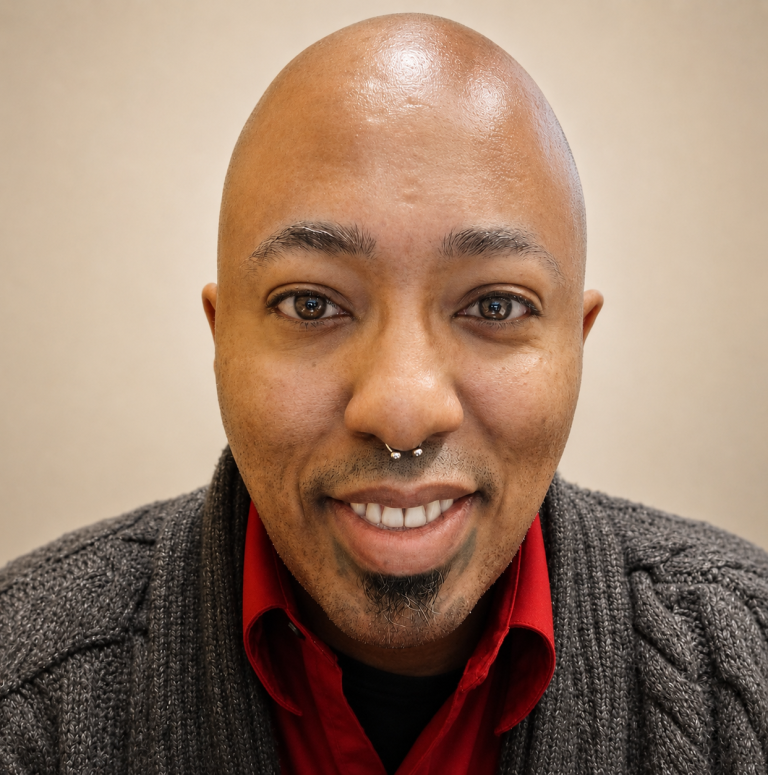
J. Catrell Bynum
Author • Clinical Mental Health Counseling Graduate Student
Jeremy Bynum is a graduate student pursuing a Master's degree in Clinical Mental Health Counseling. His passion for understanding trauma, resilience, and the human capacity to heal inspires both his academic journey and his writing.
Drawing from his studies in counseling and his commitment to mental health advocacy, Jeremy writes psychological fiction that explores the invisible battles people face every day. His debut novel, Every Monster Has a Name, is currently in development and follows the relationship between a therapist and a twelve-year-old boy whose imagined world becomes a powerful metaphor for trauma, fear, and healing.
Jeremy hopes his work will encourage readers to see that even our darkest fears can begin to lose their power once they are understood, named, and faced with compassion.
Every Monster Has A Name
Some monsters hide in the dark. Others hide behind a smile.
Introduction
Every therapist has one client they never truly leave behind.
Mine was a twelve-year-old boy named Michael Alanson who believed monsters had names.
Long before I met Michael, I spent my childhood looking for heroes.
Not the ones who could fly.
Not the ones gifted with impossible strength or brilliant inventions.
I searched for the broken ones.
The heroes who carried invisible scars beneath their masks. The ones haunted by loss, burdened by guilt, and fighting battles no one else could see. They weren't the strongest. They weren't the fastest. They simply refused to stay down, even when every reason to do so made perfect sense.
Looking back, I think I admired them because, somewhere deep inside, I needed to believe that being broken wasn't the same thing as being beyond repair.
As a child, I thought those stories were about superheroes.
As an adult, I realized they were about people.
Every mask concealed a wound.
Every villain wore the face of fear.
Every battle asked the same question.
How do you keep living after something inside you dies?
I didn't know it then, but those stories were quietly preparing me for the career I would one day choose.
Years later, I unlocked the door to my own therapy office for the first time, convinced I was ready. I had spent years studying the mind, learning to recognize symptoms, understand trauma, and helping people make sense of their pain.
Like most young therapists, I believed knowledge and compassion would be enough.
Then Michael walked through my door.
He was twelve.
Small for his age.
Quiet.
Polite.
The kind of child who apologized for taking up space.
His feet barely reached the floor when he sat across from me.
His eyes, however, belonged to someone much older.
They drifted from the window...
to the bookshelf...
to the hallway...
to the door...
before finally settling on me.
Not because he was distracted.
Because he was measuring the room.
People who have always been safe glance around a room.
People who haven't...
study it.
His case file rested unopened on my desk.
I already knew enough to understand that Michael had survived something no child should ever have to survive.
His story could wait.
Paperwork has an unfortunate habit of reducing lives to paragraphs.
Children deserve better than paragraphs.
So I closed the folder.
"I'd rather meet you," I said.
For nearly a minute, neither of us spoke.
Some silences feel uncomfortable.
This one felt patient.
Finally, I asked, "Do you know why you're here today?"
Michael shrugged.
"They think the monsters are the problem."
I waited.
He looked toward the empty corner of my office.
"They aren't."
I followed his gaze.
There was nothing there.
At least...
nothing I could see.
Looking back, I sometimes wonder if that was the exact moment this story truly began.
Not because I believed him.
I didn't.
I thought I was listening to the imagination of a frightened child.
I couldn't have been more wrong.
Michael became the lesson no classroom, textbook, or clinical training could ever teach me.
Children invent monsters all the time.
Adults call it make-believe.
Children often call it surviving.
Over the months that followed, Michael never described his pain the way adults usually do.
He never said,
"I'm afraid."
He never said,
"I feel guilty."
He never said,
"I don't know how to live with what happened."
Instead...
he introduced me to people.
A man who laughed when no one else did.
A king who demanded perfection.
A creature that waited in the darkness.
A ghost that never seemed to leave.
And a hero.
Not the strongest hero.
Not the smartest.
Not the kind who always won.
Just someone who refused to quit.
At first, I believed these stories were helping Michael escape reality.
Eventually, I realized they were helping him survive it.
That realization changed the way I understood trauma.
We often imagine trauma as nightmares.
Flashbacks.
Panic attacks.
Sometimes it is.
But sometimes trauma tells stories.
Sometimes it creates heroes.
Sometimes it creates monsters.
Not to deceive us.
To protect us.
We all create stories to survive.
Some call them memories.
Some call them beliefs.
Children often call them heroes and monsters.
Michael simply gave his stories names.
This book is about those names.
Each chapter tells the story of one monster Michael encountered.
Not because the monsters changed...
but because Michael did.
This isn't a story about superheroes.
It isn't even a story about monsters.
It's a story about survival.
About the extraordinary lengths the human mind will go to protect itself.
About what happens when fear wears a face...
when hope puts on a mask...
and when healing begins the moment we stop asking how to destroy our monsters...
and start asking why we created them.
Before this story is over, you'll meet every one of Michael's monsters.
If you're honest...
you may recognize one of your own.